
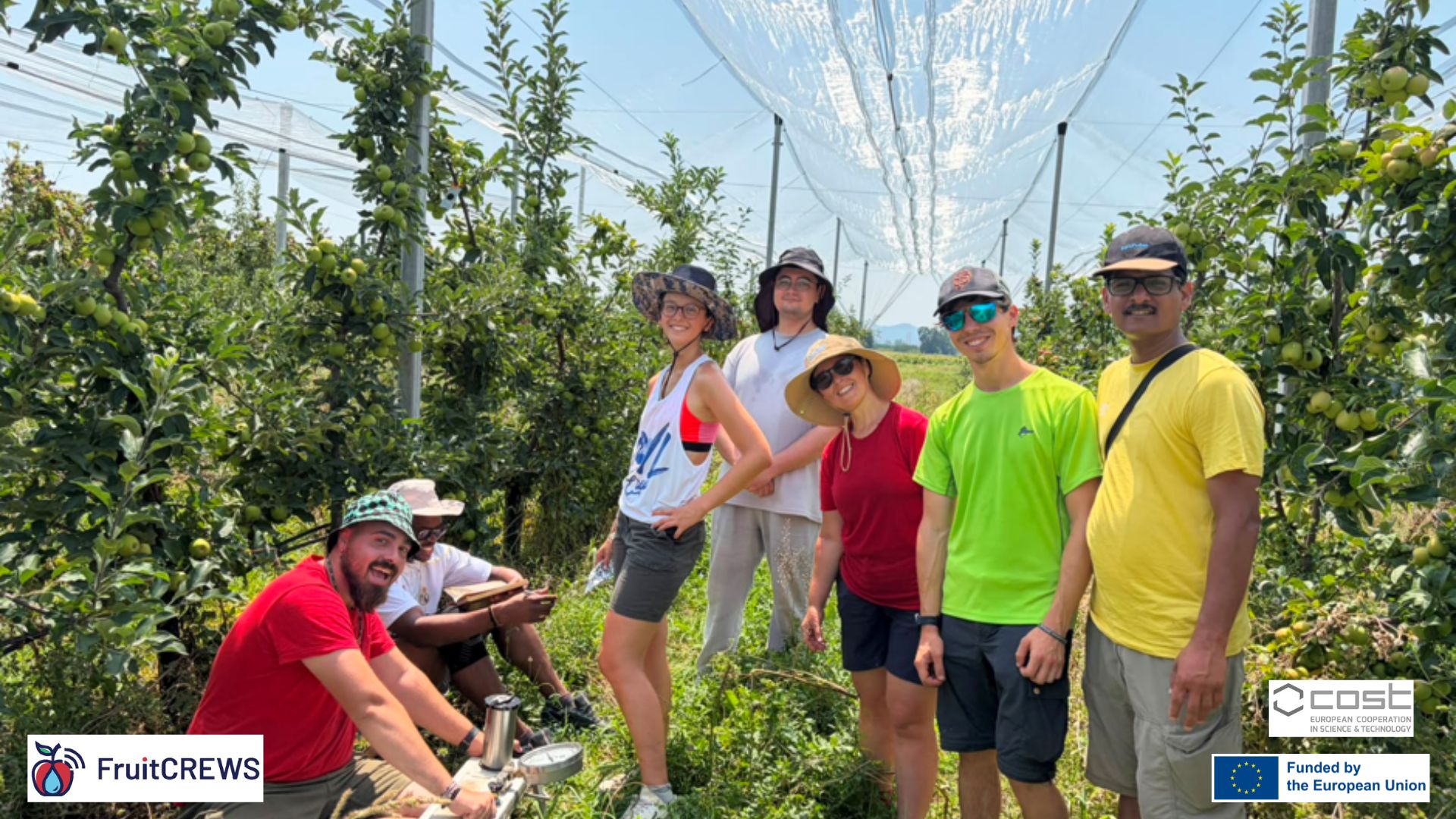
Dr. Kumud Bandhu Mishra, from Global Change Research Institute (CzechGlobe) in Czech Republic, completed a Short-Term Scientific Mission (STSM) at the Department of Agricultural and Food Sciences, University of Bologna, hosted by Prof. Brunella Morandi and her research team.
The STSM focused on the application of optical phenotyping techniques to evaluate physiological responses of fruit trees to environmental stress. Measurements included chlorophyll fluorescence (OJIP kinetics, effective quantum yield of PSII, and fluorescence imaging), leaf spectral reflectance (400–800 nm), leaf and stem water potential, and gas exchange in kiwifruit and apple orchards. The study investigated the effects of directional shading in an agrovoltaic system as well as water deficit on photosynthetic performance.
Preliminary analysis of the effective quantum yield of PSII (ΦPSII) showed that 70% directional shading generally improved photosynthetic efficiency compared with unshaded control plants, indicating reduced photoinhibition under high irradiance. East-side shading was more beneficial during the morning, whereas west-side shading better maintained PSII efficiency during the afternoon and evening, highlighting the importance of shading orientation in agrovoltaic orchard design.
The STSM strengthened collaboration between CzechGlobe and the University of Bologna and generated a comprehensive dataset that is currently being analysed. The findings are expected to contribute to joint scientific publications, future collaborative projects, and the development of non-invasive optical tools for monitoring plant stress and optimizing fruit production under changing environmental conditions.