
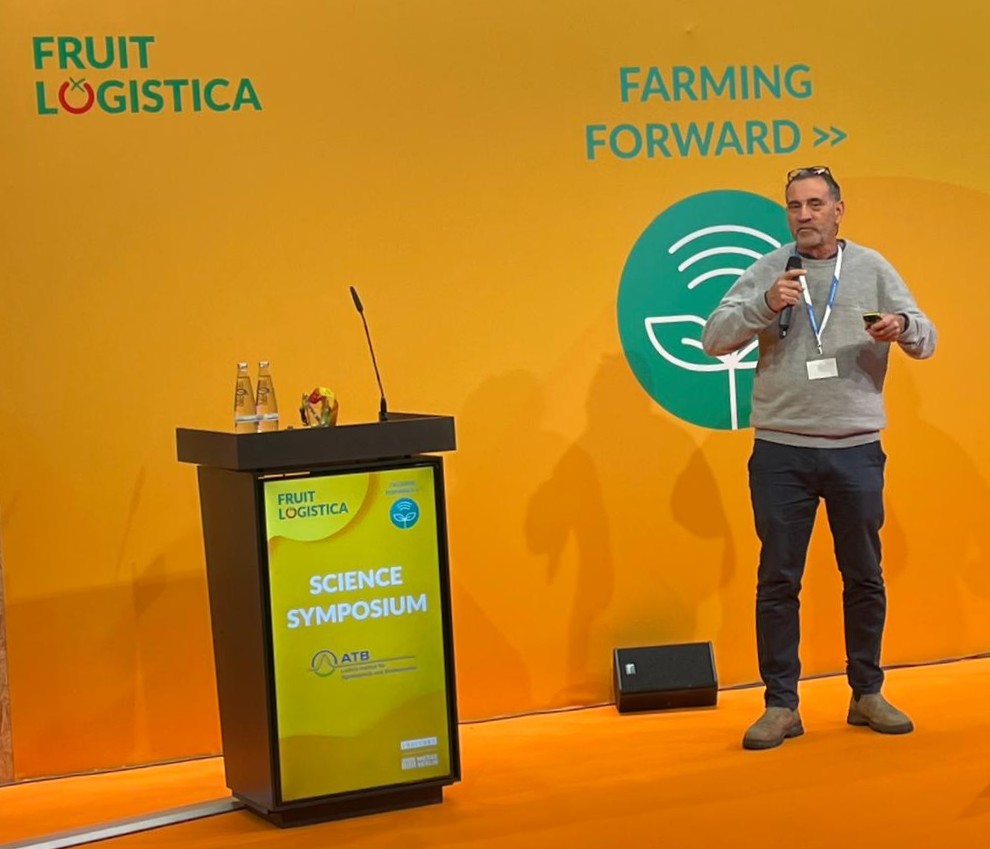
1. In two or three sentences, what was your main role in FruitCREWS, and which achievement of your Working Group (or area of responsibility) are you most proud of?
As leader of Working Group 4 (“Decision Support Systems: Advantages and Constraints”), I directed our efforts in assessing the reliability and real-world usefulness of decision support tools for fruit tree irrigation. I am most proud of bringing our community together to conduct an extensive pan-European survey of growers to understand what truly drives or hinders the adoption of these tools. The survey’s revealing insights will directly inform public policy, future research, and private-sector strategies.
2. What is your most memorable moment from the four years of the Action (a meeting, a field visit, a discussion or a person you met)?
FruitCREWS was filled with memorable moments thanks to its fantastic community, but as a senior researcher, I particularly enjoyed collaborating with our outstanding early-career scientists. Two highlights stand out: first, co-authoring a review manuscript on olive water productivity coordinated by Anabela Fernandes-Silva (University of Trás-os-Montes e Alto Douro, Portugal) and Omar Garcia-Tejera (Universidad de La Laguna, Spain), where identifying knowledge gaps and future needs together was a genuinely rewarding process. Second, WG4’s success relied heavily on the incredible drive, input, and leadership of two rising stars: Maria del Mar Borrego-Marin (University of Seville, Spain) and Alexandra Boini (University of Bologna, Italy). Seeing their impact makes me tremendously optimistic about the future of fruit tree irrigation research.
3. In one sentence: what will remain of FruitCREWS in five years’ time?
The lasting legacy of FruitCREWS will be the strong, collaborative community we built and the ongoing achievements of its members—especially our early- and mid-career researchers.
4. WG4 reviewed more than 30 irrigation decision support tools and surveyed growers in many countries. What is the most important lesson about why growers use, or do not use, these tools?
While irrigation Decision Support Systems (DSS) offer huge potential for water productivity and sustainability, their adoption remains limited by technical, economic, and contextual barriers. Our survey revealed that adoption patterns across countries and crops are driven primarily by behavioral factors such as farmer motivations and perceived risks, rather than structural characteristics alone. By identifying distinct behavioral profiles, we showed that digital transformation in agriculture must be treated as a socio-technical process, not just a technological upgrade. Moving forward, effective policies, extension strategies, and support mechanisms must account for this diversity to foster meaningful, sustained adoption.
5. Israel has managed severe water scarcity for decades. What can Europe learn from that experience, and is there anything Europe does better?
Israel’s success stems from a unique package: extreme water scarcity, a high-tech economy, centralized water management, and highly adaptive farmers willing to invest in innovation. Israel led two major breakthroughs: high-efficiency distribution systems (pioneering drip irrigation and scheduling based on meteorological and other sensor data) and utilization of non-conventional water (recycled wastewater, brackish groundwater, and desalinated seawater). As water scarcity intensifies across Europe, Israel’s efficient irrigation methods offer valuable lessons. However, because certain non-conventional water practices pose long-term environmental trade-offs, Europe should selectively adapt only what makes overall sense locally. Meanwhile, Europe currently leads in model- and sensor-based plant water physiology understanding. The key challenge now is adapting these advanced models to fit local economic, agronomic, environmental, and traditional farming realities.
6. FruitCREWS brought together partners from Europe, the Mediterranean and beyond. What did this international dimension add to the work, compared with a purely European network?
As someone coming from outside Europe, I have seen first-hand that managing tree water status is a global challenge that requires global dialogue. FruitCREWS benefited tremendously from extending its reach beyond European borders, including a strong Israeli contingent and key collaborators from North America, Africa, and Australia. Bringing these diverse geographical perspectives together enriched our collective problem-solving and ensured our findings resonated worldwide.
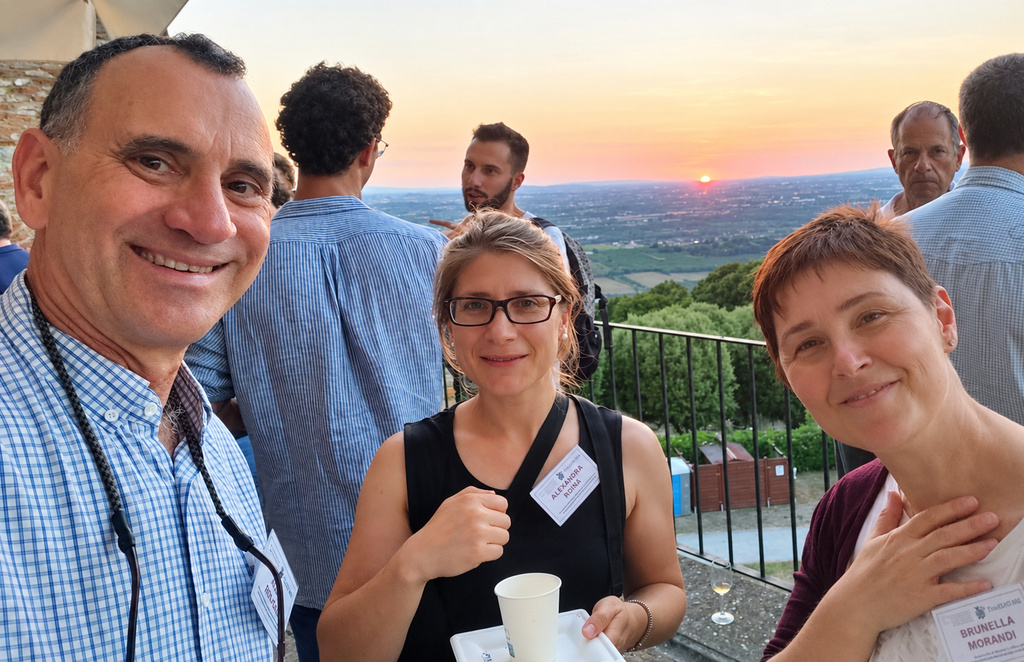
FruitCREWS meeting
Prefer to read offline? Download the interview as a PDF, here.