
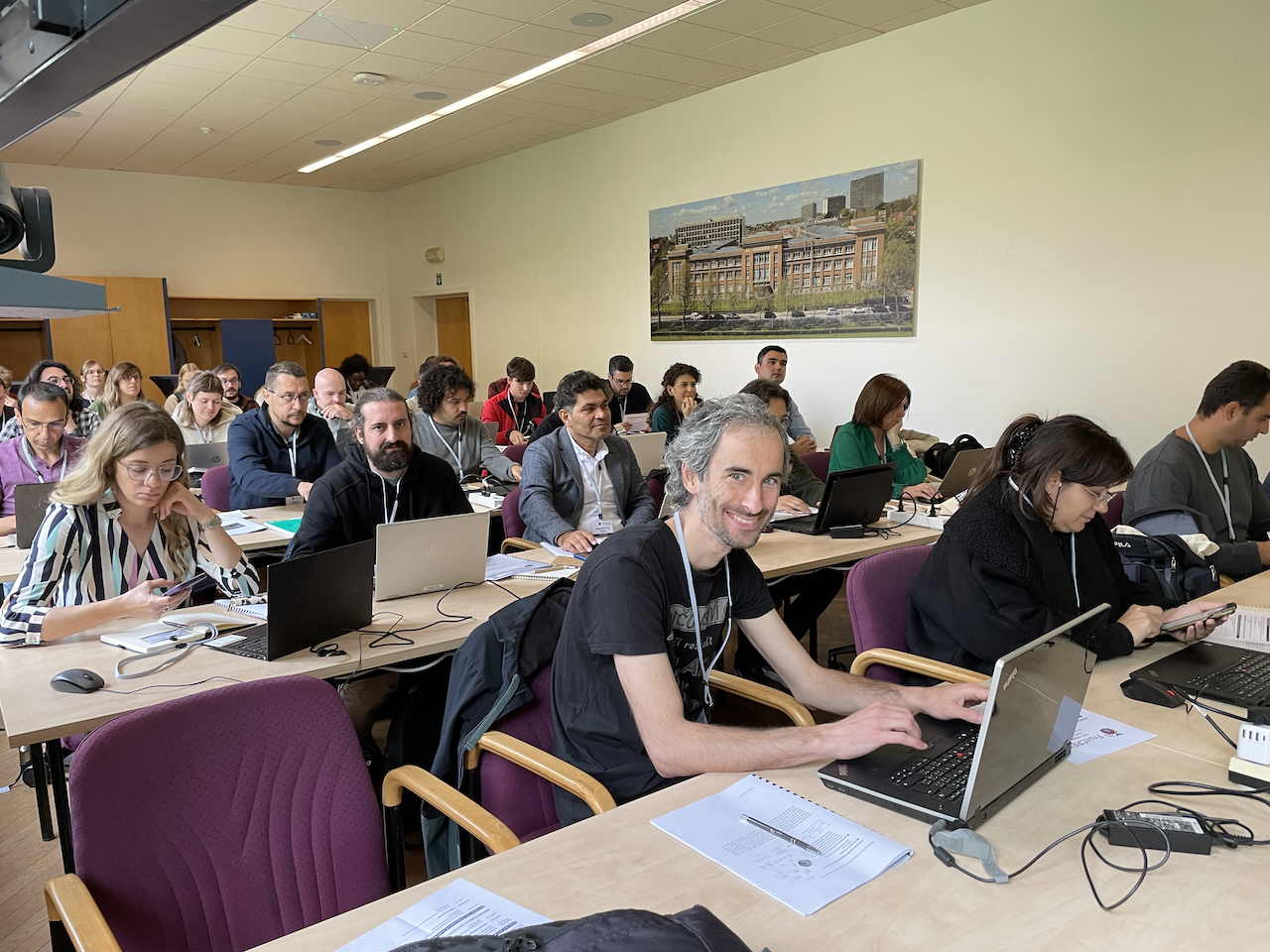
1. In two or three sentences, what was your main role in FruitCREWS, and which achievement of your Working Group (or area of responsibility) are you most proud of?
As leader of Working Group 3, I was responsible for directing our efforts to review current knowledge on irrigation management practices and suitable irrigation strategies, in order to promote solutions leading to sustainable water management and improved water productivity in the irrigation of different fruit crops. I am most proud of having taken part in building the FruitCREWS community, which connects scientists, stakeholders and growers, actively collects and reviews current knowledge, and bridges the gap between research and the practical use of new technologies.
2. What is your most memorable moment from the four years of the Action (a meeting, a field visit, a discussion or a person you met)?
FruitCREWS was built on many memorable moments, thanks to its great community. I personally enjoyed all the international events and meetings, especially the annual meetings in Bertinoro (Italy), Seville (Spain) and Naoussa (Greece), as well as the key meeting at the European Parliament in Brussels (Belgium), getting to know new people and places from around the world. I will always remember my experience at the XI International Symposium on Irrigation of Horticultural Crops, hosted by Alessio Scalisi in Tatura, Australia. As a young Working Group leader, it was a valuable experience for me to work with a group of very interesting people, experts in water management and irrigation of fruit crops. We succeeded in preparing a number of review papers, for example one on olive water productivity (coordinated by Anabela Fernandes-Silva, University of Trás-os-Montes e Alto Douro, Portugal) and one on crop evapotranspiration of strawberries (coordinated by Nataša Čereković, University of Banja Luka, Bosnia and Herzegovina). We organized several workshops and shared our knowledge at many international conferences. I think we came closer to the solutions for irrigating fruit crops in the future.
3. In one sentence: what will remain of FruitCREWS in five years’ time?
The FruitCREWS community has grown into a family in which people from all around the world are united by their efforts to build a better future for sustainable fruit growing. This legacy will continue in our future collaboration, as this is not the end, but just the beginning of a great journey.
4. WG3 reviewed irrigation scheduling protocols for many fruit crops, from apples and pears to olives and grapevines. What is the main lesson for growers who want to irrigate more precisely?
Growers who want to irrigate their crops more precisely need to focus on improving water productivity in their orchards. There is no single best solution. Growers need to adapt their decisions and orchard management practices to the crop water requirements, the specific soil and climate conditions of the area and, at the same time, to local water availability. Quantifying the right amount of water for irrigating fruit trees according to the physiological needs of the plant leads to the most precise solutions. Still, further research is needed to fully understand the interactions between plant water relations and actual water requirements in fruit orchards and vineyards.
5. In Central Europe, irrigation of orchards used to be less of a concern than in the Mediterranean. How is climate change changing this in the Czech Republic and the wider region, and what can growers there learn from southern Europe?
Growers in the Czech Republic, but also in other Central European countries, were historically used to providing fruit orchards with only supplementary irrigation in regions with a semi-humid to semi-dry climate. Many orchards were planted in areas without direct access to water resources, because rainfall during the growing season was sufficient. With climate change, extreme droughts are becoming more frequent and more intense, and many growers face new problems that cannot be solved without systematic adaptation. In these countries, we need to focus more on preserving sufficient water resources, extending irrigation infrastructure and adopting new technologies and strategies for irrigation scheduling, to secure a sustainable improvement in the water productivity of fruit orchards. Even if it first needs to be adapted to local conditions, there is a lot of knowledge and experience we can learn from southern Europe to improve the use and value of the available water.
6. FruitCREWS brought together countries with very different irrigation traditions. What did researchers from Central and Eastern Europe gain from the network, and what did they bring to it?
In general, most of the breakthrough irrigation technologies and strategies were developed in countries that have coped with drought since time immemorial, because of their long-standing needs. This is the basis on which researchers from Central and Eastern Europe build, extending knowledge about plant water relations and adapting new technologies to local climatic conditions and plant water needs.
Prefer to read offline? Download the interview as a PDF, here.