
1. In two or three sentences, what was your main role in FruitCREWS, and which achievement of your Working Group (or area of responsibility) are you most proud of?
As leader of Working Group 1 (Physiological parameters and sensing technologies), I was at the starting point of the Action’s work. Together with all the task leaders (Joaquim Bellvert, Melissa Venturi and Konni Biegert), I tried to start a fruitful discussion among the WG1 participants (around 300) about the possible difference between tree water status and tree functionality. By bringing together our experience, we realised how resilient trees are, managing water scarcity with different strategies. The challenge is to understand their language through ecophysiology and to decode their messages by means of plant-based indices and sensors.
I am proud that, together with our community, we started a science-based overview of the best indices and sensors to use for each species or cultivar and situation, following the “toolbox” approach.
2. What is your most memorable moment from the four years of the Action (a meeting, a field visit, a discussion or a person you met)?
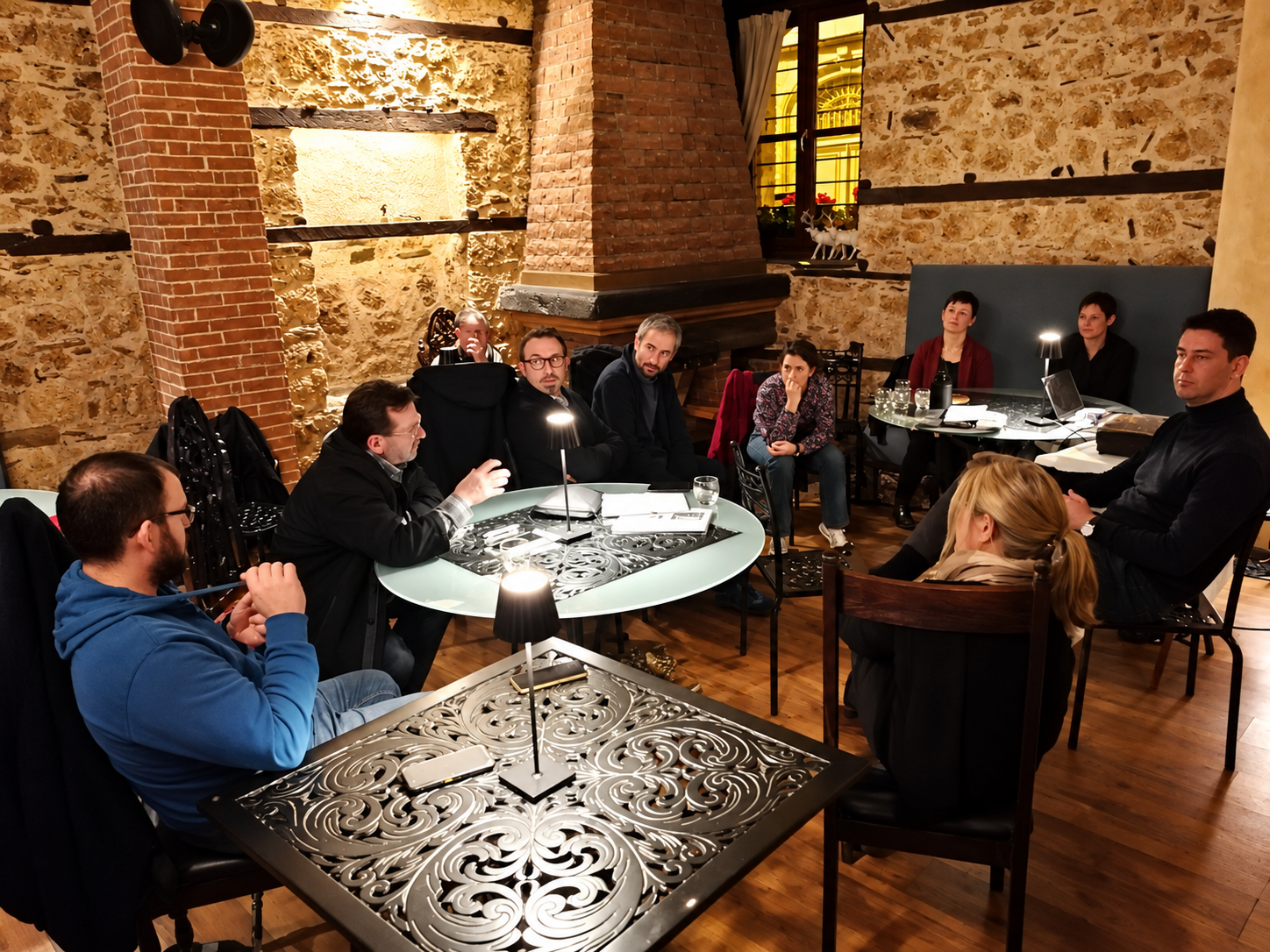
FruitCREWS was full of memorable moments, but two stand out: the first Core Group meeting in a rainy Naoussa, in front of a fireplace, where we started to plan how the Action would be carried out; and the annual meetings, which gave me the opportunity to learn a lot, above all from companies and young researchers.
3. In one sentence: what will remain of FruitCREWS in five years’ time?
The strong collaboration among the participants and the contagious enthusiasm of our young colleagues.
4. WG1 compiled 88 irrigation trial case studies, launched a Special Issue in Scientia Horticulturae and prepared crop-specific reviews. Which of these outputs will be most useful for the research community in the coming years, and why?
I cannot choose one, as I think they are all important. While the reviews and the Special Issue allowed us to consolidate current knowledge, the trial case studies give us the opportunity to carry out complex studies: finding conserved strategies across species and the related indices and sensors to use, or finding different plant behaviour according to species, pedoclimate and management.
5. Plant-based and remote sensing have advanced quickly in recent years. Which sensing approach is closest to being used routinely by growers, and what is still holding it back?
Again, I need to recall the “toolbox” approach: it will depend on the species and the situation. Of course, according to researchers, stomatal conductance and photosynthesis are the most reliable indicators, but today measuring them is complex and time-consuming. On the other hand, thermal imaging seemed promising but is not always reliable. The challenge is to find an indirect way to estimate the most reliable indicators using other sensors or models (see WG2), and for me this is an amazing challenge.
6. The FruitCREWS Position Paper calls for more research on how trees adapt to drought, salinity and heat waves. Which open questions in tree physiology would you put at the top of the research agenda?
I believe it is of fundamental importance to study the resilience strategies trees use to manage water scarcity, in order to learn from them and to develop agricultural practices accordingly.
Prefer to read offline? Download the interview as a PDF, here.